Showing posts with label Morrisburg. Show all posts

Thursday, May 3, 2012

A Glimpse of Morrisburg’s History


The sparkling blue water of the St. Lawrence River is an essential part of the spirit of Morrisburg, Ontario, the river shaping the very foundation of the town. Resilient United Empire Loyalists and settlers carved homesteads and farms out of the forested wilderness in Upper Canada’s Dundas County, creating a small village named West Williamsburg. 

By 1832, the community on the St. Lawrence River shore received a Royal Mail post office. The river was the fastest transportation route between Montreal and the Great Lakes, vessels serving settlements along the way. The rapids in the St. Lawrence River were a shipping hindrance and safety hazard. Between 1843 and 1856, a series of canals and locks were constructed on the north side of the great river near West Williamsburg to circumnavigate the rapids. Politician James Morris of Brockville promoted the Williamsburg Canal project and helped the Upper Canada House of Assembly with funding. The canals brought commerce and new residents to the village.
James Morris, circa 1840
In 1851, Morris was appointed the first Postmaster General of the United Province of Canada. For his dedication to the waterway development, the residents of West Williamsburg honoured him in the same year, renaming the village “Morrisburgh,” later spelled “Morrisburg.” In 1864, he returned the honour by providing funds for a town bell.
Main street Morrisburg looking west, ca 1910
Incorporated as a village in 1860, Morrisburg was home to flourishing industries: a gristmill, a carding mill, and a fanning mill. Wharves were erected for shipping, and the first trains chugged through in 1855. Churches and schools were constructed and a thriving market brought sellers and buyers together from miles around. Two banks were ready to serve the prosperous villagers – Molson’s Bank and the Bank of Ottawa. The hamlet grew steadily with stately, large homes lining the unpaved streets, later used as tourist residences.
Southwest panorama of Morrisburg
By the mid-20th century, modernization in shipping and the urgent need for hydro-electric power dams demanded the widening of the St. Lawrence River. The planned St. Lawrence Seaway expansion permanently altered Morrisburg and nearby towns. The timed release of water on July 1, 1958 left approximately 1/3 of Morrisburg permanently underwater. Before the flooding took place, nearly 90 of the town’s homes and buildings were moved to higher ground. Buildings that could not be moved were demolished or left in place. New homes and a plaza replaced the submerged section of Morrisburg, constructed away from the waterfront.

The St. Lawrence River continued to influence the town with Morrisburg transforming into a lively waterfront playground. The Old Power House near Lock 23 in front of the town became an attractive site for scuba divers, the submerged stone building covered with barnacles and home to an abundance of underwater life. Each summer for over 40 years, the town has hosted “Tubie Races” weekends, drawing buoyant local and distant crowds to the river’s edge. A sparsely populated frontier village in the early 1800s, Morrisburg developed into a modern small town, the great St. Lawrence River entrenched in its past and still shaping its future.
By Susanna Mcleod

36 First Street, Morrisburg


 Russell Manor was built in the early 1870s. It is a tribute to its French Second Empire architecture. Named after its builder Thomas Russell, the Manor is situated in the historic section of the Village. The Manor offers all the Old World comforts one expects from a house of its time.


36 First Street, Morrisburg
 In 2001, Michael and Ron took a life-changing trip to New Orleans. To say they fell in love with the city and its architecture is an understatement. Seven whirlwind days in and around the French Quarter and the Garden District left them with the indelible desire to create something similar for themselves back at home in Ontario. At the time, they were living in Ottawa’s Chinatown, in a century home too small for Michael’s decorating ambitions.
Michael, as many of his clients will attest, is a chameleon decorator. He’ll take on the character of his client and subtly transform their ideas into reality. Michael has been an interior decorator for over 25 years. Never having had to advertise his services, he has worked continuously in the Ottawa area where he has helped homeowners with every aspect of home décor. For the past eight years, Michael has also been decorating model homes for Richcraft Developments of Ottawa, as well as extending his services to new clients along the St. Lawrence Seaway.

In the last 10 years, Michael has become somewhat of a specialist in decorating the century home. His forte is Victorian; and his aim is not to re-create Victoriana but to adapt it to the 21st Century. He doesn’t copy what the Victorians did; instead, he interprets what they would have done were they alive today. Just take a look at his use of stencils and paint washes and you will understand. He takes Victorian elements and translates them into today’s reality. When it comes to fabric, Michael is a supreme artist. A trained couturier, it’s little wonder that his window dressings look a lot like ball gowns. Michael has used hundreds of yards of fabric in the Manor’s décor.
Lighting is also a prime point of interior decoration for Michael. From pinpoints of modern halogens, to re-wired garage sale finds, to pieces acquired at auction, the Manor's lighting runs the gamut. As those who know him will agree, Michael has a penchant for the decorative arts. Why have one statue when two, three or even more will do? Capo diMonte, you say; Michael will take three!
What to do with their desire to create a bit of Louisiana in Ontario led them to purchase a house large enough to fulfill their desire to open a bed and breakfast. Never having stayed in one didn’t deter them from setting about to open one. They thought they knew what people would want in a B&B.
The Manor’s purchase also allowed Michael to fulfill his lifelong desire to live in, and decorate, a Victorian home. It allowed Ron to fulfill his need to feed the masses and garden as much as humanly possible. In fact, opening a B&B was the only way they could justify buying such a huge home!

Russel Manor today

Russell Manor, known to many as just “The Manor”, is the result of their long search for a suitable property. A group home for almost 40 years prior to its purchase, and a perfect example of French Second Empire architecture, Russell Manor was six years in the making. To say it needed some TLC does not do justice to the term “tender loving care”. The house had been sadly neglected. Although it had been modified to play the role of group home, none of these modifications were so egregious that a little decorating magic (and a great deal of hard work) couldn’t take care of them. Undaunted, they undertook the renovations with zeal. Their neighbours, on the other hand, thought they were both completely mad!
It was soon decided that The Manor would not be your typical B&B. Somewhere along the way, the decision was made to run the B&B more like a small boutique hotel. Each room is lavishly decorated in a distinct manner. There are two 2-room suites. All four rooms have ensuite bathrooms. Breakfast is served in the suites, if that is the wish of the guests. And, if it isn’t, guests can congregate in either the gorgeous dining room or, weather permitting, in the heavenly courtyard to indulge in one of Ron’s fabulous breakfasts.

Wednesday, May 2, 2012

31 Lakeshore Drive, Morrisburg

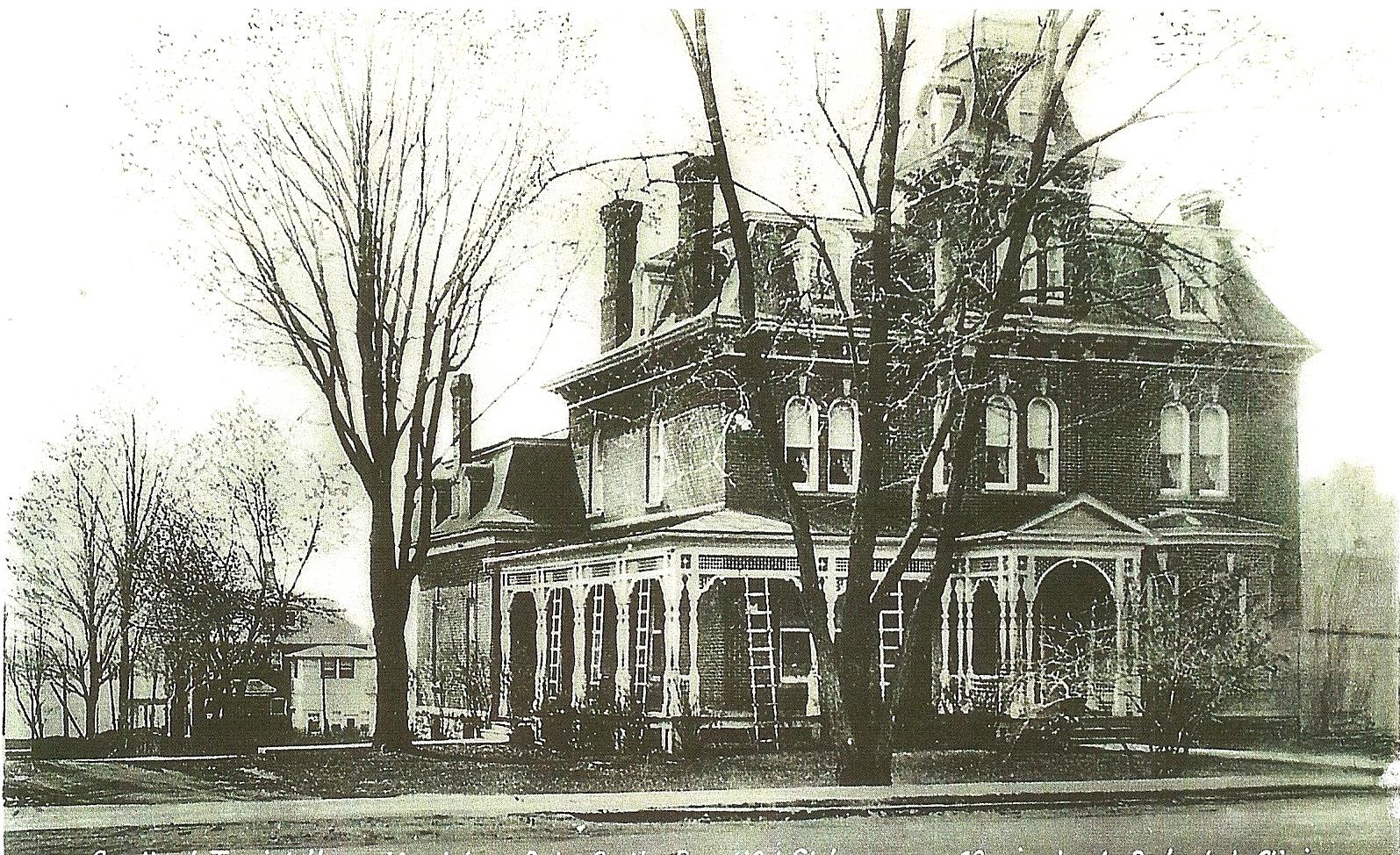
The original property, at the corner of Main and Stafford Street, facing the St. Lawrence River, was purchased by the late Dr. Theodore F. Chamberlain in 1873. Twelve years earlier, he had married Annetta Jane Parish from Athens, Ontario. He and his bride enjoyed a honeymoon vacation in Atlantic City. While there, in the vicinity of the Boardwalk, Dr. Chamberlain spied the home of which he had dreamed. He secured the plans, and in 1874 he built the stately red brick residence at Morrisburg, which old-timers still speak of as "the old Chamberlain house".
31 Lakeshore Drive, Morrisburg
 A story has often been told of the period following World War I when influenza swept the country and many people died. For some uncanny reason, Dr. Chamberlain's patients all survived. Edwin P. Foster, County Liquor Inspector, received a complaint that Dr. Chamberlain had been obtaining an unusually large number of cases of Scotch Whiskey. A charge was laid and when he appeared in court, Dr. Chamberlain, a noted orator, conducted his own defense. He called as a witness, Les VanAllan, Morrisburg's harness maker and lay preacher, noted for never having permitted liquor to touch his lips. Mr. VanAllan testified that the doctor's medicine had saved his life and that of his wife. The magistrate requested information regarding the ingredients of the medicine, whereupon Dr. Chamberlain, with thumbs hooked in the armholes of natty embroidered vest, staunchly stood his ground, saying "That, Your Worship, is a medical secret, that I am not at liberty to divulge". The charge was dismissed. 

Dr. Theodore F. Chamberlain
 
His government service at an end, the indefatigable Chamberlain returned to Morrisburg, where he again worked as a physician, dispensed veterinary medicine, and, until 1919, ran a sanatorium out of his large residence. Widowed in July 1924, he died of pneumonia at his retirement cottage at Chaffey's Lock in 1927 and was buried in the family plot in Athens. Three storey’s in height, it was surrounded on the front and East by spacious galleries. A conservatory with colorful stained- glassed windows added balance and charm to the West wing. The third floor, with panels of hand-picked ash paneling and jutting dormer windows became a private hospital, where resident patients were treated.

Dr. George M. Gorrell and his prize "Lunge"
caught in the St.Lawrence river in 1914.
31 Lakeshore Drive, Morrisburg
Over the years, the Chamberlain house changed owners. It belonged, in turn, to the doctor's son, W. P. Chamberlain, to Albert G.F. Drew, and to Watson Parish. ln 1915, the property was purchased by the late Fred H. Meikle who retained the South portion facing the river and sold the house to Michael J. Casselman, the father of the late Arza Clair Casselman, former M.P for Grenville-Dundas. Following a brief; unsuccessful attempt by a trio of investors from the United States to operate a tourist home under the name of the “Cardinal”, in 1939 Dr. George M. Gorrell became the owner of what is one of Morrisburg's most historic and picturesque residences.